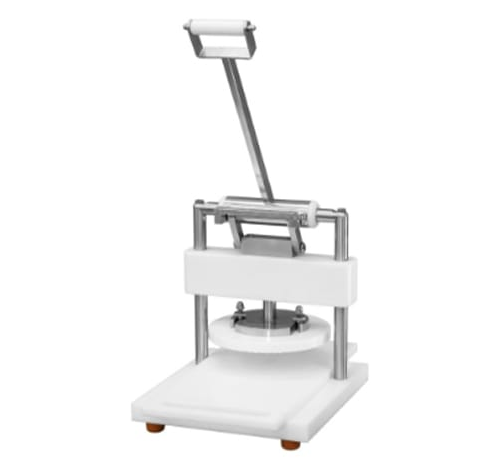
A commercial meat press can appear mechanically simple: a frame, a handle and pressing surfaces. That appearance can create the expectation that the machine should also be inexpensive. In practice, the visible simplicity of the operating process does not tell you how the machine was engineered or manufactured.
Manual Describes the Operation, Not the Engineering
“Manual” means the operator provides the movement instead of an electric or pneumatic actuator. It does not mean the frame, leverage system, guides or pressing components are lightly engineered. A purpose-built meat press has to convert operator input into a controlled pressing action while remaining aligned through repeated cycles.
Meat Creates a Different Mechanical Requirement
Meat and poultry resist flattening differently from soft dough. A press intended for schnitzel, chicken breast, pork, veal or beef portions must be evaluated around those loads and the finished result required. That is one reason visual similarity to another type of press does not establish that the machines are equivalent.
Structure, Leverage and Alignment Matter
The frame must remain rigid enough for the intended load, the leverage geometry must provide useful mechanical advantage, and the pressing surfaces need to stay controlled and aligned. Those requirements are not always obvious when looking at the outside of a machine.
Commercial Construction Adds Cost
Food-contact materials, machined components, guides, bearings, fasteners and the quality of fabrication all contribute to manufacturing cost. A machine intended for repeated commercial use also has to be built differently from a light-duty appliance used occasionally.
Simple Operation Is a Benefit
For the operator, fewer controls and a straightforward pressing cycle can be an advantage. The goal is not to make the machine look complicated; it is to make the job simple while the underlying structure does the work reliably.
Compare Application, Not Appearance
A dough press, patty former and meat flattener may all involve pressing, but each can be engineered around a different product and result. Price should therefore be considered together with intended use, construction, production requirements and suitability—not simply the number of visible parts.
For a broader comparison, read Dough Press vs Meat Press: Why They Are Not the Same Machine.
Frequently Asked Questions
Why can a manual meat press be expensive?
Manual describes the operating method, not the engineering level. Commercial performance depends on structure, leverage, alignment, food-contact construction and durability under repeated meat-flattening loads.
Should I compare a meat press with a dough press by price?
Price alone does not establish that two machines are interchangeable. Compare the product, load and application each press was designed to handle.
Need Help Evaluating a Meat Press?
Tell us the product, starting dimensions, target thickness, expected volume and delivery location. We can help you evaluate the equipment around the application.