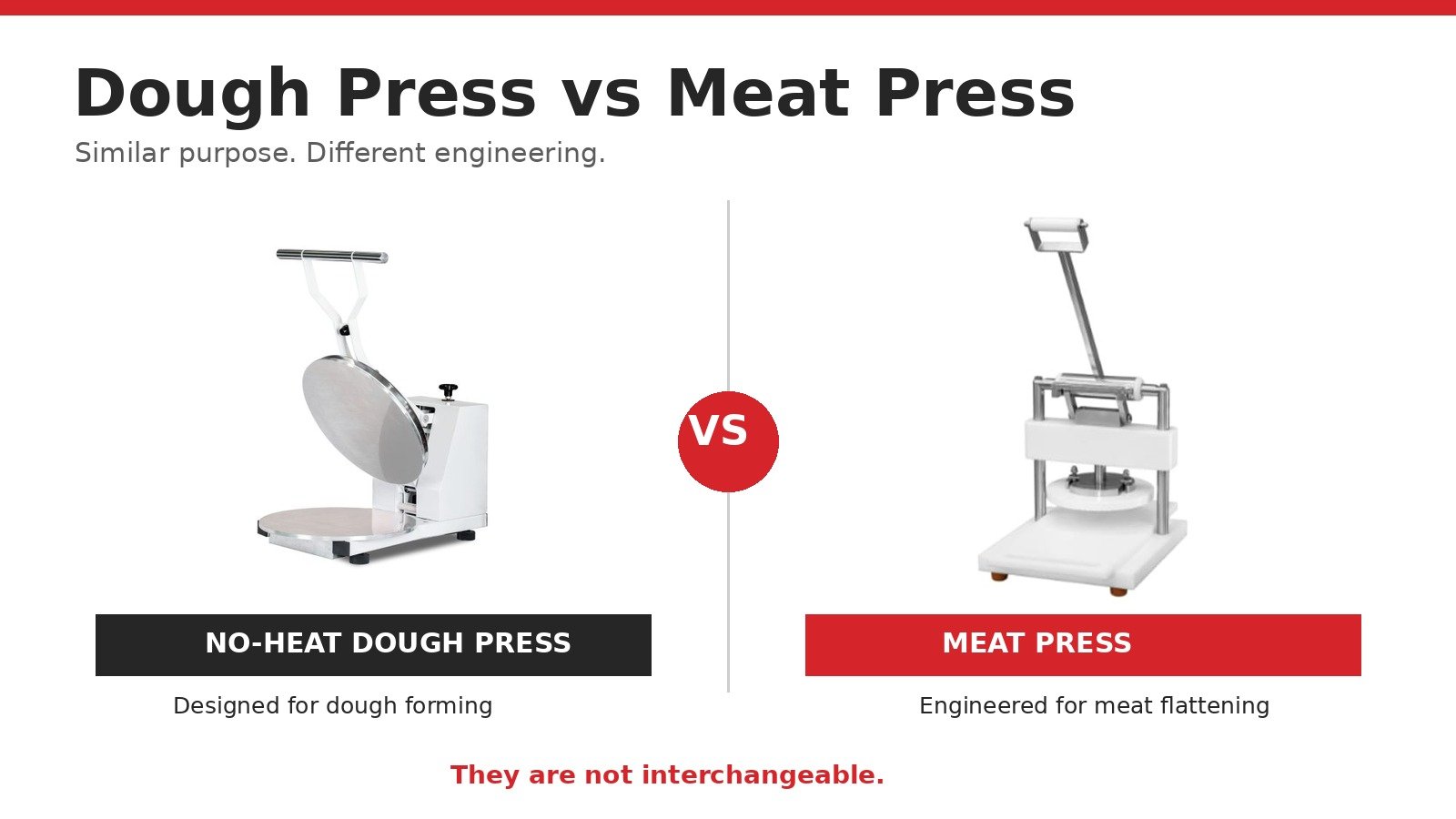
At first glance, a dough press and a meat press can appear to do the same thing: product is placed between pressing surfaces and compressed to a thinner, more uniform shape. That visual similarity is exactly why customers sometimes ask whether a dough press being considered as an alternative can be used for schnitzel, chicken breast, pork cutlets or other meat portions.
The important distinction is that the two machines are designed around different products, different resistance to deformation and different operating objectives. A commercial dough press is engineered to form pliable dough. A commercial meat press is engineered to flatten muscle tissue and protein portions consistently.
An Apples-to-Apples Comparison: No-Heat Dough Press vs. Meat Press
To make the comparison fair, we are not using a heated dough press as the example. A non-heated commercial dough press removes the obvious heating difference and allows the comparison to focus on the underlying application and engineering.
No-Heat Dough Press
Primary product: Dough
Purpose: Form and press pizza, tortilla, flatbread and similar dough products.
Engineering priority: Controlled forming of soft, extensible dough with repeatable thickness.
Commercial Meat Press
Primary product: Meat and poultry portions
Purpose: Flatten schnitzel, chicken breast, pork cutlets, beef cutlets and similar portions.
Engineering priority: Mechanical strength, leverage, controlled thickness and repeated meat-flattening duty.
Why Pressing Force Matters
Dough is normally soft, elastic and readily deformable. Raw meat contains muscle fibres and connective tissue. Flattening it evenly can demand substantially more mechanical resistance from the machine than shaping dough.
That does not mean every meat press has the same force rating, and it does not mean every dough press is weak. It means the machine must be evaluated for its intended load and application. A machine designed for dough should not automatically be assumed to have the frame strength, leverage, platen support or duty cycle required for meat.
Platen Design and Product Behaviour Are Different
On a dough press, platen geometry, thickness adjustment and—in many models—temperature control are selected around dough forming. The goal is typically a repeatable disc or sheet without overworking the dough.
On a meat press, the objective is different. The machine must spread a resistant protein portion while maintaining control of finished thickness. The platen, linkage and support structure therefore need to suit the forces generated during repeated flattening.
Why Choosing a Press by Price Alone Can Be a False Economy
Why the Meat Press Can Cost More Than It Looks
A dough press and a meat press may fall into very different price ranges depending on their size, controls, construction and intended duty. Price alone does not determine whether one can substitute for the other. The important question is what the machine was engineered to process.
A commercial manual meat press can look mechanically straightforward because it is intentionally designed to be simple for the operator. That does not mean it is simple to engineer or inexpensive to manufacture. The structure, linkage geometry, alignment, pressing components and food-contact construction all have to work together under repeated meat-flattening loads.
In other words, simple operation is a design outcome, not evidence of simple construction. A purpose-built meat press may therefore carry a price that surprises customers who judge it mainly by its simple appearance. The correct comparison is between the machine and the duty it was engineered to perform—not an assumption that a dough press should be cheaper or that either category is interchangeable.
- Insufficient flattening performance can lead to inconsistent meat thickness.
- Operators may need more effort or repeated pressing cycles.
- Throughput may be lower than expected.
- Using equipment outside its intended application can increase wear.
- Cleaning and food-contact design may not match the intended meat-processing workflow.
The safe purchasing rule is simple: do not assume a dough press is suitable for meat unless the manufacturer specifically approves that application.
Which Machine Should You Choose?
If you are making pizza bases, tortillas, flatbreads or similar dough products, start with our commercial dough press range. If your application is schnitzel, chicken breast, pork, veal, beef cutlets or another meat portion, review the meat presses and flatteners designed for that work.
Frequently Asked Questions
Can I use a dough press to flatten meat?
Only if the manufacturer specifically approves the machine for that application. Similar appearance does not mean the press is engineered for meat flattening.
Why can a meat press cost more than customers expect?
A professional meat press may require a more rigid structure, purpose-built leverage, aligned pressing components and food-contact construction designed for repeated meat-flattening loads. “Manual” describes how the machine is actuated; it does not mean the machine is simple to engineer or inexpensive to manufacture. Price should be compared against intended duty, not appearance alone.
Does choosing a no-heat dough press make it equivalent to a meat press?
No. Removing heat makes the comparison more direct, but the machine is still engineered around dough forming rather than meat flattening.
Need Help Choosing the Correct Press?
Tell us what product you are pressing, your target thickness or size, expected production volume and delivery location. We can help narrow the equipment selection.