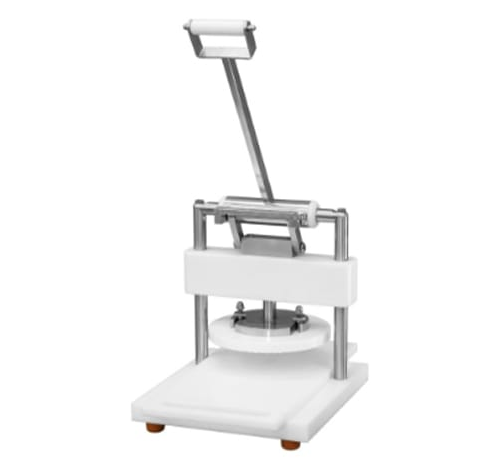
A commercial meat press should be selected around the protein, target thickness and expected workflow. The correct press is not simply the machine with the largest platen or lowest price.
Start With the Product
Chicken breast, pork cutlets, veal, beef cutlets and schnitzel can differ in size, thickness and resistance. Identify the largest normal portion and the finished thickness you need to achieve.
Consider Platen Size and Adjustment
The platen must provide enough working area for the portion while the thickness adjustment needs to cover your finished specification.
Manual Operation Can Be an Advantage
A manual press can be straightforward to install because it does not require electrical power. It also gives the operator direct control over the pressing action. Suitability still depends on required throughput and operator workflow.
Construction and Food Contact
Review the materials used in food-contact areas and how easily the pressing surfaces and surrounding structure can be cleaned between production runs.
Do Not Substitute a Dough Press Without Approval
Meat can impose a different mechanical load from dough. If the intended product is meat or poultry, start with equipment designed for meat flattening rather than assuming a dough machine will do the same work.
Review MPP-MP-01 Manual Meat Press & Flattener or visit our Meat Presses & Flatteners page.
Finished Thickness Is a Production Specification
For many processors, the reason for flattening is not simply appearance. More uniform thickness can help standardize cooking time, portion presentation and downstream handling. Define the finished thickness range you need and confirm that the press adjustment can cover it.
Think About the Largest Normal Portion
Choose the platen around the products you actually run. A machine may handle a typical cutlet comfortably but become awkward if larger chicken breasts or pork portions frequently extend beyond the pressing area. The largest routine product is usually the better sizing reference.
Operator Effort and Throughput
Manual pressing places the operator directly in control of each cycle. That can be simple and reliable, but expected volume still matters. A restaurant preparing portions in batches has a different workflow from a high-volume production room. Discuss how many portions are required per hour or per shift rather than focusing only on the machine footprint.
Cleaning Access Matters
Meat processing makes sanitation especially important. Review how the food-contact platen and product support surfaces are accessed, whether removable parts are provided and how the machine fits into the facility's sanitation procedure. The easiest machine to buy is not always the easiest machine to clean every day.
Compare Purpose-Built Equipment
When price pressure leads to consideration of a dough press, compare the intended engineering rather than the visual similarity. A meat press should be evaluated for repeated protein flattening, while a dough press should be evaluated for forming dough. The correct comparison is between machines designed for the same application.
Information to Send With an Inquiry
For a useful recommendation, include the meat type, approximate raw dimensions, starting thickness, desired finished thickness, portion weight, required output and any space limitations. Photos of the product can also help clarify the application when dimensions alone do not tell the full story.
Frequently Asked Questions
What products can a commercial meat press flatten?
Depending on the specific model, typical applications can include chicken breast, schnitzel, pork cutlets, veal and beef cutlets.
Does a manual meat press need electricity?
A fully manual model such as MPP-MP-01 does not require an electrical connection.
Can I use a dough press instead?
Do not assume that a dough press is suitable for meat. Use equipment specifically approved for the intended product and load.
Need Help Choosing the Correct Press?
Tell us what product you are pressing, your target thickness or size, expected production volume and delivery location. We can help narrow the equipment selection.